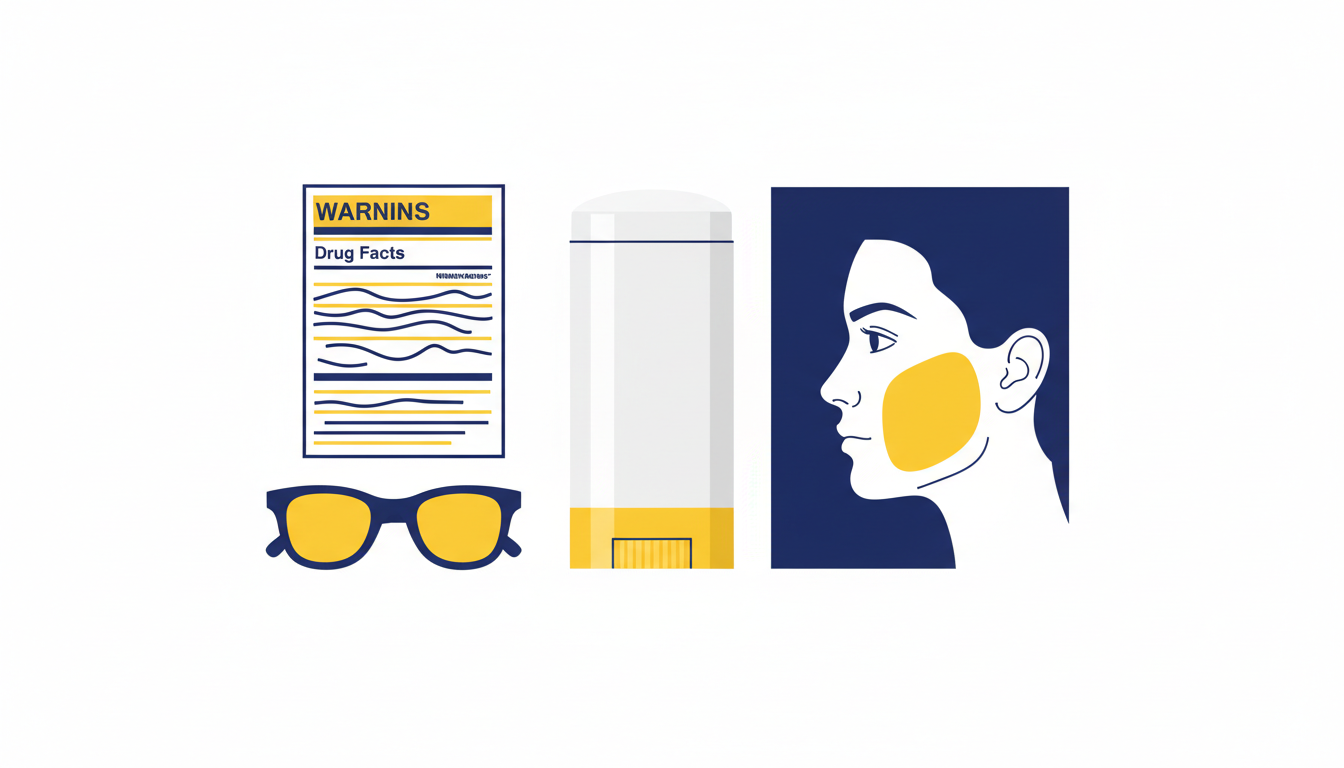
Quick answer: To protect skin near the eyes, read the sunscreen’s Drug Facts Warnings and Directions before choosing a format. FDA advises avoiding the eyes and mouth when applying sunscreen. The American Academy of Dermatology (AAD) says a sunscreen stick can help around the eyes because it is less likely to run. Neither recommendation means putting sunscreen in the eyes or ignoring the product’s specific warning.
The eye-area decision is two separate checks
For adults over 40, the question is not simply whether a product is marketed as a “face sunscreen.” You need to decide (1) whether its labeled UV protection meets the outing’s needs and (2) whether its directions and warnings allow the way you intend to apply it. A comfortable-looking face product is not automatically appropriate for the eyelids or lash line.
| Evidence track | Look for | Do not infer |
|---|---|---|
| UV protection | Broad Spectrum, SPF value, water-resistance claim when relevant | “For face” means broad spectrum or water resistant |
| Eye-area use | Drug Facts Warnings, Directions, and any specific keep-out-of-eyes instruction | “Stick” means safe to apply inside the eye or on every part of the eyelid |
| Format | Stick, lotion, or spray; application method prescribed by the label | All formats can be sprayed or rubbed around eyes interchangeably |
What we verified against published guidance
Desk-based source comparison, November 3, 2026: We compared the FDA’s consumer sunscreen page and its sunscreen labeling guidance with two AAD instructions on selecting and applying sunscreen. This is an original comparison of official directions, not a wear test, skin-sensitivity trial, product endorsement or claim that we used a sunscreen personally.
- FDA consumer guidance: Apply enough sunscreen to exposed skin while avoiding eyes and mouth; follow labeled reapplication directions and use other sun-protection measures. Read FDA guidance.
- FDA sunscreen labeling guidance: Drug Facts warnings include instructions to keep product out of eyes and rinse with water to remove it if contact occurs. Read the exact package because products may carry additional warnings. Read FDA labeling guidance.
- AAD selection advice: A stick is a practical format around the eyes to reduce dripping, while choosing broad-spectrum SPF 30 or higher and water resistance remains important. Read AAD advice.
- AAD stick application advice: Pass a stick back and forth four times over each skin area to help achieve adequate coverage; do not apply a spray around the face or mouth. Read AAD application guidance.
Our finding: A stick may help control placement, but the warning does not disappear when the delivery format changes. Read both UV claims and application restrictions. Published guidance does not establish that one stick is non-irritating for every user, that its SPF lasts longer, or that eye-area skin can be left unprotected without other measures.
Four real-world decisions to make before going outside
| Situation | Decision | Next action |
|---|---|---|
| Lotion runs toward eyes with sweat | Do not assume a higher SPF prevents running | Consider a labeled sunscreen stick on nearby skin, avoid eye contact, and add UV-blocking sunglasses |
| Only an aerosol spray is available | Do not spray toward face or eyes | Follow the package directions and AAD spray precautions; choose a different application method or format for the face |
| Outdoor activity includes swimming | SPF and water-resistance duration are different fields | Check 40- or 80-minute water-resistance wording; reapply as directed and immediately after towel drying |
| Stinging or rash develops | Do not continue simply because the product says “sensitive” | Stop use; rinse product from eyes with water if it enters them; seek clinical advice for persistent symptoms |
A repeatable five-field eye-area label card
Copy these fields from the actual package, not a cropped marketplace photo:
- Exact product and form: ______ (stick / lotion / spray).
- Broad Spectrum and SPF: ______.
- Water resistance: none claimed / 40 minutes / 80 minutes.
- Warnings and eye-contact instructions: ______.
- Directions and reapplication: ______. Decision: use as labeled / choose another format / seek guidance if uncertain.
Hypothetical example: A shopper finds a Broad Spectrum SPF 30 stick but cannot read its back-panel Warnings in a store listing. The appropriate conclusion is “not yet verified,” not “safe for eyelids.” They request the actual Drug Facts photograph, check the eye warning, and use sunglasses and shade while resolving uncertainty. This example is fictional and is not evidence about a particular brand.
What to avoid when interpreting marketing language
- “Ophthalmologist tested”: Do not read the phrase as permission to put sunscreen into the eyes. Follow the full directions and warnings.
- “Mineral” or “gentle”: These terms do not replace a personal sensitivity assessment or the Drug Facts panel.
- “Waterproof”: FDA does not permit waterproof or sweatproof sunscreen labeling claims; look for the tested 40- or 80-minute water-resistance wording instead.
- “All day”: Sunscreen still requires reapplication according to its label, commonly at least every two hours and after relevant water or towel exposure.
Protection beyond the cream or stick
Use a wide-brimmed hat, shade and sunglasses with UV protection along with a broad-spectrum sunscreen on exposed skin. AAD notes that large or wraparound frames provide more coverage around the eyes than smaller frames. If an application site is restricted by a product warning or causes irritation, physical sun-protection measures are especially important; do not improvise by applying the product inside the eye.
For the adjacent decision on how to apply another format, read our stick-versus-lotion coverage check. For sprays, consult the spray-sunscreen label guide. The Start Here page explains our label-audit method.
Source, limits, and correction policy
Sources checked November 3, 2026: FDA sunscreen consumer guidance; FDA sunscreen labeling guide; AAD sunscreen selection; AAD stick and spray use; AAD sun-protective clothing. This is educational label analysis; we have not personally tested any product or verified individual tolerability. If eye pain, vision changes or ongoing irritation occur, obtain medical advice promptly. See our editorial policy or contact us to report a correction.