
Quick answer: Before introducing a new cosmetic product into your routine, the American Academy of Dermatology (AAD) recommends testing a small patch of skin twice daily for seven to ten days, according to the product’s normal use. A home check may reveal irritation, but it cannot rule out every allergy or replace a dermatologist’s medical patch test.
Maybe your skin feels drier than it did a decade ago. Maybe a friend loves a new serum, or you found a moisturizer with an impressive ingredient list. In your 40s, 50s, or any decade, it is tempting to try a promising product on your whole face immediately. A short, thoughtful testing routine is a more useful first step than trusting a dramatic before-and-after advertisement.
Why a small-area test is worth considering
Skincare products can cause uncomfortable reactions even when they are labeled gentle or designed for sensitive skin. Irritation and allergic contact dermatitis are different possibilities. The way a product feels on someone else does not predict how your skin will respond.
The AAD advises trying a skincare product on a small area before adding it to a normal routine. This simple home process is a practical precaution—not proof that a particular formula is safe for every person or every part of the body.
Step 1: Choose just one new product
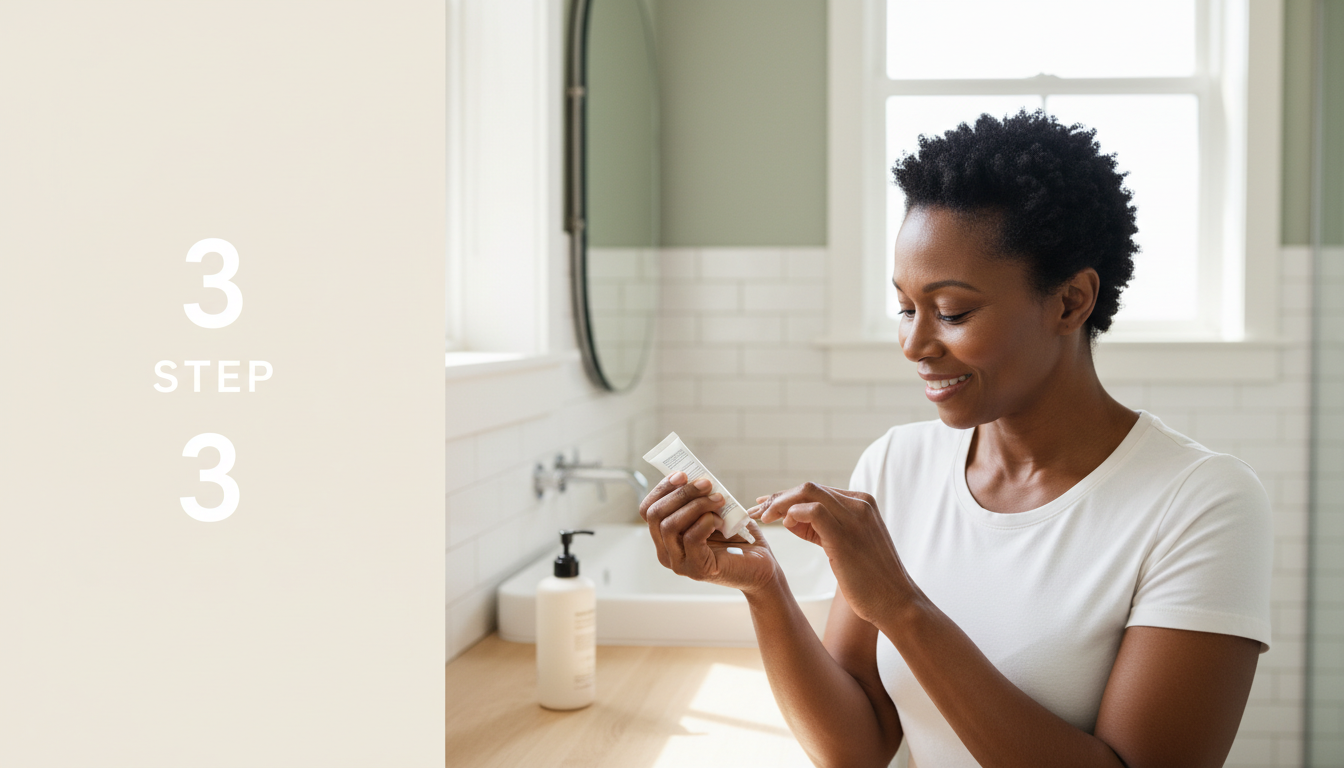
Try New Skincare Carefully
1. Pick a small area: Follow the product’s recommended use.
2. Observe for 7–10 days: Check a small test area as AAD advises.
3. Watch reactions: Stop for irritation; home checks cannot exclude allergy.
Start with one product instead of changing your cleanser, moisturizer, serum, and sunscreen all at once. If you introduce multiple items simultaneously, you may not know which product is causing a problem.
Read the ingredient list, directions, and any warnings. If you have a known allergy or a history of serious reactions, ask a qualified dermatologist or allergy specialist what testing is appropriate rather than experimenting at home.
Step 2: Pick an appropriate small test spot
For an ordinary skincare product, the AAD suggests a quarter-sized spot, such as the underside of an arm or the bend of an elbow, where the product will not be quickly rubbed or washed away. Choose intact skin rather than an open wound or active rash.
Use the usual amount and thickness you would use in everyday application. Do not test an undiluted ingredient, a prescription medicine, or a product contrary to the instructions simply because an online checklist suggests doing so.
Step 3: Follow the 7–10 day observation routine
For applicable cosmetic products, the AAD describes applying the item twice each day for seven to ten days. Leave it on for the length of time you would normally use it. If it is a rinse-off cleanser, the AAD notes that testing involves about five minutes or the time specified in the instructions rather than leaving it on all day.
Set a reminder only if it helps. You do not need an elaborate tracking app or a paid skincare subscription. A paper note recording the day, product, and any visible change is enough for an ordinary home observation.
Step 4: Watch for signs of a reaction
Notice redness, itching, swelling, burning, or other uncomfortable changes. Different reactions can look different across skin tones, so pay attention to how the area feels as well as its appearance.
If a reaction occurs, the AAD advises gently washing the product off as soon as possible and not using it again. A cool compress or petroleum jelly may help with minor discomfort if suitable; severe or persistent reactions need professional care. Seek urgent medical help for breathing trouble, facial or throat swelling, or other signs of a severe allergic reaction.
Step 5: Introduce the product thoughtfully if no reaction occurs
If the test area remains comfortable through the observation period, you can consider using the product according to the label. This does not guarantee that sensitive facial skin or later repeated use will never react. Continue to observe and avoid adding several other new products at the same time.
Some active ingredients, such as retinol or glycolic acid, may be irritating in normal use; the AAD discusses this distinction. A home test cannot tell you whether a specific concentration or combination is appropriate for a particular skin condition.
Home testing versus medical patch testing
A home trial is not the diagnostic patch testing performed by a dermatologist or another qualified clinician. Medical patch testing may be recommended when the cause of allergic contact dermatitis is uncertain, and it uses specialized methods to investigate possible allergens.
If your skin repeatedly reacts to products, do not keep testing more items in the hope that the next one will work. A board-certified dermatologist can evaluate symptoms and recommend a safer plan.
Your simple product observation log
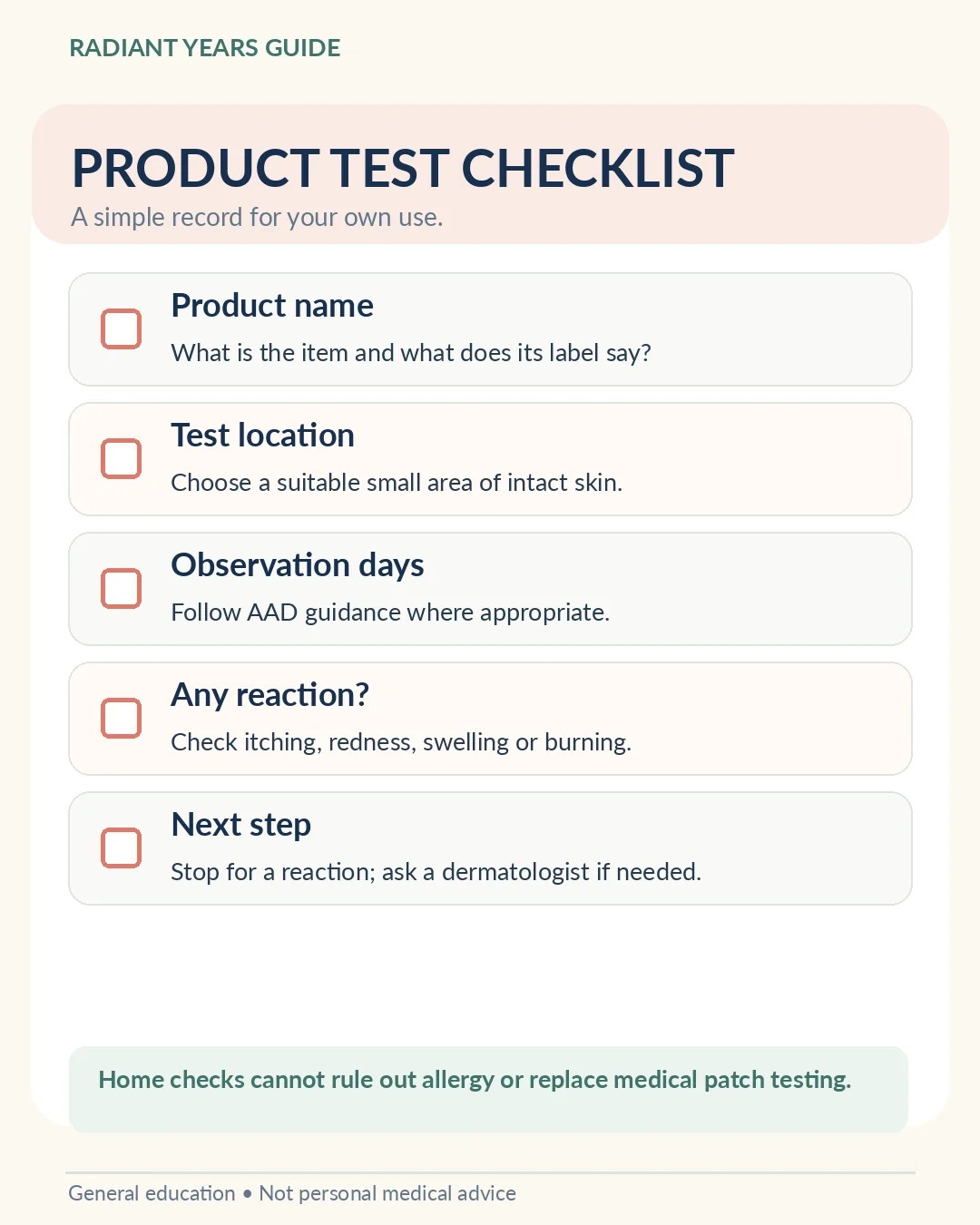
- Product: Write down the full name and whether it is a cleanser, moisturizer, or another product.
- Test spot: Record the small skin area you chose.
- Days used: Note the applications during the seven-to-ten-day window, when appropriate.
- Skin response: Record changes in appearance and comfort without trying to diagnose them.
- Decision: Continue cautiously, stop the product, or seek professional advice.
Common mistakes to avoid
- Trying several new products on the face simultaneously.
- Assuming the word ‘natural’ or ‘hypoallergenic’ means a reaction is impossible.
- Testing a product on broken or severely irritated skin.
- Ignoring the manufacturer’s directions or washing-off time.
- Continuing despite a significant reaction or using the home process instead of medical advice.
A realistic example for a busy week
Imagine you are considering a fragrance-free moisturizer. You first check its label, choose a suitable small area of intact skin, and follow the AAD observation approach where appropriate. You note any discomfort rather than taking photographs you do not need. Once the observation period ends, you decide whether to introduce it to your usual routine or ask a dermatologist for help.
This approach is designed to reduce guesswork and unnecessary purchases. It is not a promise that you will avoid all skin reactions, and it is not a substitute for care when symptoms are serious.
Frequently asked questions
Will a 7–10 day check prove I am not allergic?
No. It may help identify an obvious problem before widespread use, but it does not rule out all future reactions or replace clinician-directed allergy testing.
What if a product makes my skin sting?
Stop using it if you develop an uncomfortable reaction. Wash it off gently, and seek professional help for symptoms that are severe, unusual, or do not settle.
Can I use this method for prescriptions or known allergies?
Do not replace a prescriber’s directions or an allergist’s guidance with a general cosmetic testing routine. Ask the clinician managing your condition.
Trusted references
- American Academy of Dermatology — How to Test Skin Care Products
- AAD — Dermatologists’ Tips for Relieving Dry Skin
Keep exploring Radiant Years Guide
- How to Read Skincare Product Labels After 40 — Understand claims and ingredient lists.
- How to Choose a Moisturizer After 40 — Compare lotions, creams and ointments.
- A Simple Skincare Routine for Your 40s and 50s — Put gentle care into daily practice.
Editorial note: This article is general educational guidance, not a personal diagnosis or medically reviewed recommendation. AAD is cited as an external source, not as an endorsement of this website. Illustrative images are not records of actual clinical tests.
