
Quick answer: A personal health information folder is a private place to keep key healthcare facts and the locations of important records. Begin with your current medicines, care contacts, allergies if known, insurance information and a plan for keeping the information up to date.
A medical appointment may go smoothly until a clinician asks which medicine you take, where your last test was completed or whom to contact if the office needs a prior record. Those details can be difficult to recall in the moment. A simple personal folder can make your information easier to find without requiring an expensive app or complicated filing system.
This guide is for organizing information, not diagnosing a condition or making legal decisions for you. The National Institute on Aging (NIA) emphasizes keeping important records together and updating medication information regularly.
First: choose a private format that actually works
You might prefer a paper binder, a small folder in a locked drawer or an encrypted digital folder. There is no single required setup. Choose a method you can update and find again when you need it.
Privacy matters: never upload medical records, insurance numbers, passwords, Social Security numbers or medicine lists to a public blog comment or general website contact form. If you use a digital service, review its security and sharing controls.
Section 1: A one-page health snapshot

Organize Health Information
1. Care contacts: Keep clinician and pharmacy details together.
2. Medicine overview: Record current medicines and known allergies.
3. Maintain privacy: Secure the folder and update it as needed.
Start with a small cover page summarizing what a healthcare professional might need to know. You may include your preferred name, relevant care contacts, important allergies and major conditions that are appropriate to share with your own care team.
Keep it short. The folder should point to trustworthy records, not attempt to recreate an entire medical history from memory. Verify details against provider records or a patient portal when possible.
Section 2: A current medicine and supplement list
According to the NIA, a useful medication list includes prescription medicines, over-the-counter drugs, vitamins and dietary supplements. Note the product name, the amount taken and when it is taken. Include the prescriber or pharmacy if that helps you verify the record.
Do not change or stop any medicines based on an organizing worksheet. Review discrepancies with a pharmacist or clinician, especially when multiple providers prescribe treatments.
Section 3: Doctor, pharmacy and emergency contacts
Record relevant clinician names, clinic numbers, preferred pharmacy and trusted emergency contacts. Check that numbers are current, especially after a move, insurance change or provider transition.
Make a conscious decision about who can see this information. A trusted person may need to know where the folder is in an emergency, but that does not mean everyone needs access to the contents.
Section 4: Insurance and record locations
Include enough information to find your current health plan, patient portal instructions and the locations of meaningful reports. For security, a note saying ‘insurance card stored in locked folder’ may be safer than scattering full account or policy numbers across multiple devices.
The NIA’s broader important-documents checklist discusses keeping important paperwork in one place and letting an appropriate trusted person know where it can be found.
Section 5: Questions, visits and follow-up
Add a blank page for upcoming appointments. Before the visit, write down two or three important questions, recent changes, and any details you want to explain. Afterward, record the clinician’s instructions or refer to the official after-visit summary rather than guessing what was said.
Store referrals, recent results and follow-up dates in an organized section. This folder is not a substitute for your healthcare provider’s clinical record.
Section 6: Future planning documents
Depending on your circumstances, you may wish to record the location of an advance directive, health care proxy information or other documents relevant to future decisions. Requirements and terminology vary by U.S. state.
The NIA advises discussing future healthcare preferences with your doctor and people you trust. This article is not legal advice and does not tell you to sign any specific form. A qualified legal or healthcare professional can explain the options that apply where you live.
A private one-page folder index
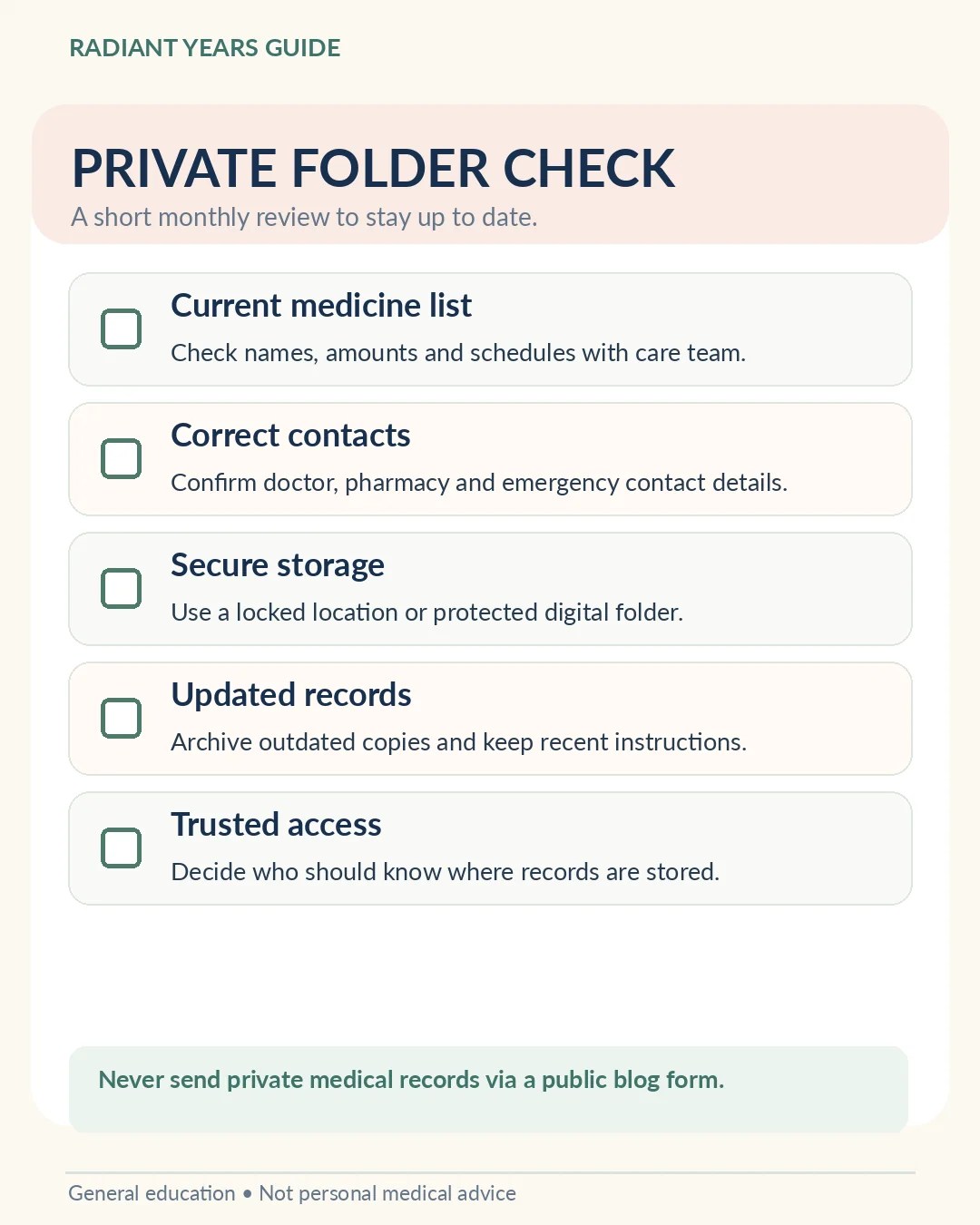
- Health snapshot: Where is my verified summary of important care details?
- Medication list: When did I last check names, amounts and schedules?
- Contacts: Are my clinician, pharmacy and emergency contact details current?
- Insurance: Where are my current card and documents stored?
- Appointments: Where can I find recent after-visit instructions and the next date?
- Future planning: If relevant, where are important planning documents kept?
Keep it useful with a ten-minute monthly review
Pick a recurring date to check whether you changed medicines, providers, pharmacies or contact details. Cross out outdated information or archive it securely so the current version is easy to identify. Review the folder after a major medical visit as well.
A monthly reminder is a personal organization idea, not a medical requirement. You may need more frequent updates if medicines or care arrangements change.
Three security mistakes to avoid
- Leaving printed medication and insurance records visible in a public or shared space.
- Emailing sensitive records to strangers or submitting them through an unrelated website contact form.
- Keeping multiple conflicting versions without marking which one is current.
Frequently asked questions
Should I keep all medical records in one folder?
You can keep essential summaries and references to where other records are stored rather than copying everything. Access and privacy should guide the choice.
Can a phone note replace paper?
It may work for some people if it is protected, accessible and easy to update. A simple paper method may be better for others; consider what happens if a device is lost or inaccessible.
Does this replace a doctor or a legal adviser?
No. Use professional help for medical care, medication changes, advance directives and other legal decisions.
Trusted references
- NIA — Getting Your Affairs in Order: Documents to Prepare
- NIA — Taking Medicines Safely as You Age
- NIA — Caregiver Worksheets
Keep exploring Radiant Years Guide
- How to Prepare for a Doctor’s Appointment After 50 — Turn your notes into useful questions.
- A Home Safety Checklist for Healthy Aging — Review important home safety habits.
- How to Stay Socially Connected as You Age — Think about trusted people and support.
Editorial note: General informational guidance, not personalized medical, legal, or data-security advice. Do not submit personal medical details to Radiant Years Guide’s contact form. All illustrations use fictional details rather than real patient information.
