
Quick answer: Be cautious when an online health advertisement promises one ‘miracle’ product for many illnesses, guaranteed rapid results, secret cures, or urgent payment. The U.S. Federal Trade Commission (FTC) advises independent research, checking claims with a health professional, and resisting high-pressure sales tactics.
People looking for better sleep, healthy skin, mobility or long-term wellbeing deserve useful information—not a sales pitch that exploits their concerns. Health-related scams may appear in professional-looking websites, videos, social-media posts, or sponsored search results. Age does not determine whether someone can be tricked: these tactics can target anyone.
Why a polished ad does not prove a product works
A beautiful website, a ‘doctor’ photo, a dramatic patient story or an impressive chart can be persuasive. The FTC warns that endorsements can be fabricated, actors can appear in testimonials, and scientific-sounding phrases can be used without reliable evidence.
This makes careful verification more important than whether a page looks professional. An advertisement is a source of claims, not proof of the claims.
Warning sign 1: One product claims to cure everything
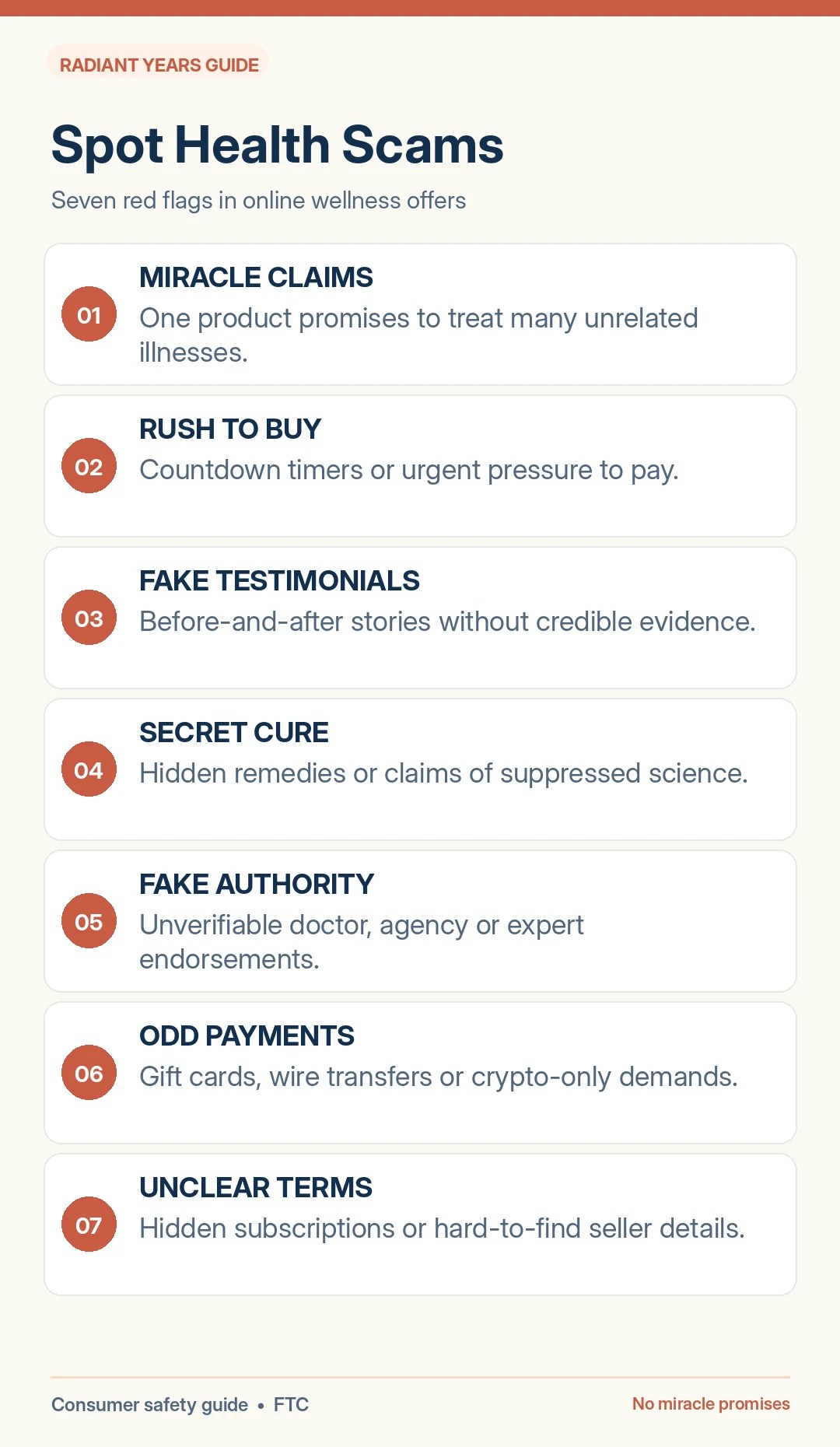
If the same pill, cream or device supposedly treats numerous unrelated diseases, be skeptical. Real medical conditions have different causes and clinical considerations. An extraordinary promise needs robust, relevant evidence—not just a collection of anecdotes.
Do not stop proven treatment or change prescribed medicines because an advertisement says a secret product works better.
Warning sign 2: The seller demands immediate action
Countdown timers, repeated ‘only today’ messages and warnings that you must pay before an offer disappears can be pressure tactics. The FTC says urgency is a common feature of scams because it reduces the time people have to verify claims.
Close the page or step away. A legitimate question about health should allow time to consult a qualified professional.
Warning sign 3: Testimonials replace trustworthy studies
A story about a stranger’s remarkable result may feel convincing, but you often cannot verify what happened. Even genuine personal experiences do not show that the product will work for you or that it is safe.
Look for meaningful clinical evidence that directly supports the product’s claims, reviewed from independent and credible sources. A list of scientific words is not the same as a relevant study.
Warning sign 4: ‘Natural,’ ‘ancient,’ or ‘secret’ is treated as proof
The FTC warns that natural-sounding labels do not guarantee a product is safe or effective. Some supplements and treatments can interfere with medicines or medical conditions.
Ask a doctor or pharmacist about risks, especially when you take regular prescriptions or manage a chronic condition. Do not use a marketing term as a safety certificate.
Warning sign 5: A fake authority logo or endorsement
Advertisements may imitate government or healthcare logos or suggest that an agency approved a claim. Look for direct verification through the official agency’s website rather than clicking the ad’s own ‘proof’ link.
An FDA, FTC, or professional-society name appearing near a product does not establish that the organization endorsed it. Use official government domains to understand regulatory status.
Warning sign 6: Unusual payment or privacy requests
Be especially cautious if an unexpected seller insists on a gift card, cryptocurrency, wire transfer, or payment-app transfer. The FTC also warns against giving financial or identifying information in response to unsolicited messages.
Never send Medicare, Social Security, bank, or medical account details through an unfamiliar advertisement or unverified site. When in doubt, leave the page and reach the organization using independently verified contact details.
Warning sign 7: The price or subscription terms are confusing
A free trial can become a recurring payment if terms are unclear. Review the total charge, subscription terms, cancellation policy and who actually operates the seller. Keep a copy of material terms if you decide to buy.
If you cannot identify the company or determine how to cancel, reconsider the transaction. This is a consumer-verification step, not an endorsement of any product.
A realistic example: an advertised ‘joint miracle’ supplement
Imagine an ad says one capsule repairs joints, reverses aging and produces dramatic results in a week. It features a doctor-like figure and a countdown timer. Rather than sharing your credit card number, search for the company name independently, check credible health information and ask a clinician about claimed benefits and interactions.
The same approach applies to skin products, immunity products, weight-loss promises and other wellness offers. A product may be legitimate or not; the point is to verify evidence instead of trusting pressure.
What to do if you suspect a scam
Stop engaging with the seller. If money was sent, contact your bank or payment company promptly to ask about protective steps or disputing the charge. If personal information was shared, take appropriate security measures such as changing compromised passwords and checking accounts.
The FTC accepts reports at ReportFraud.ftc.gov. Reporting does not guarantee recovery, but it may help identify patterns and warn others. If you believe you are experiencing a medical emergency or dangerous adverse reaction, seek timely medical care.
The 7 Questions to Ask Before You Buy
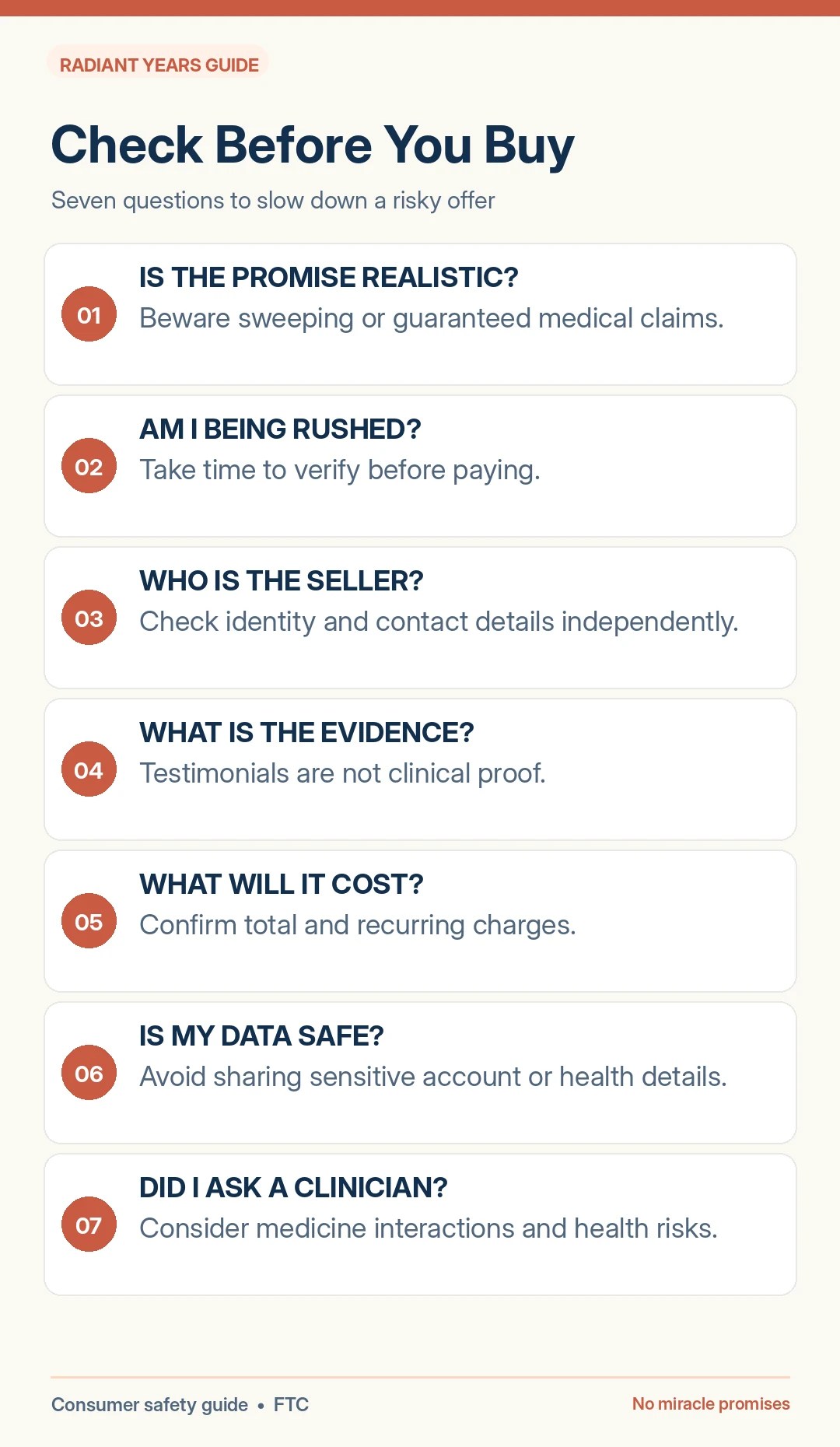
- Does this product promise an implausible cure or several unrelated benefits?
- Is the seller pushing me to pay right now?
- Are the testimonials independently verifiable?
- Is the clinical evidence directly relevant and credible?
- Can I verify the organization, business and contact information myself?
- Are the total price, recurring charges and cancellation terms clear?
- Have I asked a qualified clinician about potential health risks and interactions?
Frequently Asked Questions
Does a positive review prove a treatment works?
No. Reviews and personal testimonials are not reliable clinical evidence; they may be incomplete, misleading or fabricated.
Are all online health products scams?
No. The aim is to evaluate specific claims and seller behavior carefully, not to assume every product or seller is dishonest.
Where can I report suspicious claims?
The FTC directs consumers to ReportFraud.ftc.gov. For safety concerns involving a medicine or medical product, consult official FDA reporting guidance and your healthcare professional as appropriate.
Official Sources and Further Reading
- FTC — Common Health Scams
- FTC — How to Spot and Avoid Common Health Scams
- FTC — How to Avoid a Scam
- Federal Trade Commission — ReportFraud
What to Read Next
- How to Read Skincare Product Labels — Check cosmetic marketing claims.
- How to Test a New Skincare Product — Use sensible precautions before adding products.
- Your Personal Health Information Folder After 50 — Keep your private health information organized.
Editorial note: General consumer education based on FTC guidance. This publication does not provide personal medical, legal, or financial advice and does not investigate or endorse particular sellers. Images use fictional examples, not actual victims or companies.
